
Organs, matracas (Church rattles) and bands in Europe and the New World: 18th–20th centuries (ARLAC)
Image: Diego Delso, CC BY-SA 4.0, via Wikimedia Commons

Organized by the IMS Study Group “Early Music and the New World.”
Presentations in this Session
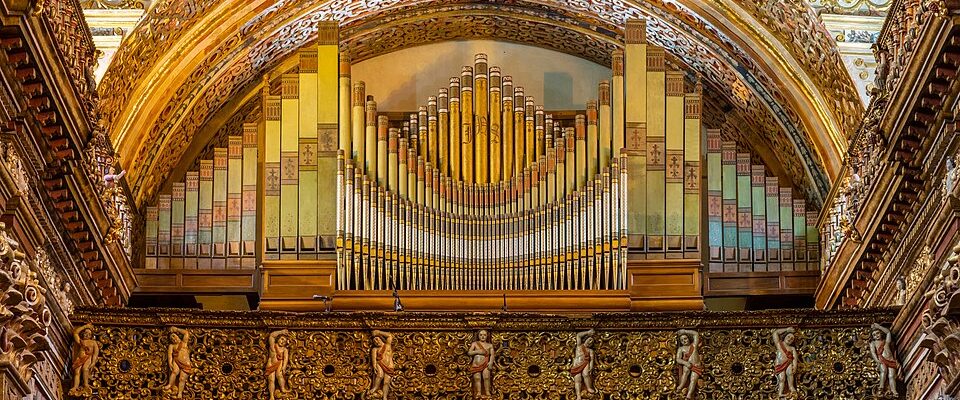
The Roosevelt organ (1888) at the Compañía de Jesús Church in Quito, Ecuador
Amongst the more than thirty historical organs preserved in Ecuador today, we find several foreign made “romantic” instruments that arrived between 1850 and 1930. The Compañía de Jesús Church in Quito has a splendid example made in 1888 by the Roosevelt Organ Works, an American organ building company established by Frank Roosevelt (1862–95) and his brother in 1872. Before this one, the church had several Baroque organs, unfortunately not preserved today. The organ, made at the Roosevelt atelier, displays superior constructive quality, has two keyboards and pedal and is an outstanding example of romantic organ making in the Latin American Andes. This paper analyzes the instrument from technical, design, and constructive perspectives, situating it within the broader production of the Roosevelt company and within the organ landscape of Ecuador at the time of its arrival.
Mechanical organs in Colombia: The Aeolian Organ of the San José Chapel (Jesuit Church), Bogotá, and the Walcker Organola at Cali Cathedral
The Aeolian organ at the San José Chapel in Bogotá (Op. 846) represents a pivotal milestone in organ-building history, the advent of mechanical self-playing instruments driven by perforated rolls, where the performer could focus on registration and dynamics while the mechanism handled technical execution. Although contracted in 1905, physical evidence suggests a manufacturing date prior to 1899, revealing a purely pneumatic instrument uniquely powered by original hand-pumped bellows. Major European firms, such as E.F. Walcker & Cie., rapidly integrated similar automated technology into their instrument production with the Organola as the specimen (Op. 2092) of 1925 preserved at Cali Cathedral. Recognizing Aeolian’s global dominance, Walcker specifically designed its Organola to be compatible with Aeolian’s vast organ roll catalog, ensuring these repertoires could be performed even in regions lacking professional organists. This paper shows how automated instruments mediated between technological innovation and musical practice, facilitating new forms of circulation and performance.
The Acoustic Heritage of Two Catalan Matraques
The “matraca de campanar” is a large rotating wooden idiophone traditionally installed in bell towers to replace silenced bells during Holy Week. As it rotates, wooden mallets strike boards or resonant boxes, producing a powerful percussive signal. This talk presents an interdisciplinary study of two matraques from the towns of Ripoll and Cervera (Catalonia). Through in situ acoustic measurements, multi-position field recordings, and architectural analysis, the study investigates how instrument design and spatial context shape their acoustic output. The results reveal distinct acoustic characteristics between the two instruments, demonstrating regional variation in Catalonian Holy Week sound practices. By combining acoustic, architectural, and historical perspectives, the talk positions the matraca as a key element of Catalonia’s intangible acoustic heritage.
Matracas in Latin America: The case of Colombia
This paper deals with the use of rattles (crotalus) in churches in the Hispanic world and specifically about the few instruments that had been preserved in churches and church inventories in present day Colombia from the 18th to the 20th centuries. Traditionally, in the catholic West, church bells are silenced during Holy Week after the Gloria on Maundy Thursday and sound again only on Easter Vigil. In the meantime, rattles were and are used to replace the bells in their function of summoning the faithful to the church. The paper also addresses the challenges of organological classification, proposing a revised approach based on the mechanics of these instruments before turning to their historical documentation.
Augusto Azzali (1863–1907): Opera and bands in Colombia, Mexico, and the United States
From the mid 1850s onwards, a handful of Italian musicians arrived in Colombia as part of itinerant opera companies and played a fundamental role in the development of opera, musical institutions and the reform and institutionalization of military bands, as well as in the renewal of their repertoires. This paper examines the activities in the field of military bands by the Italian composer, director and impresario Augusto Azzali between 1891 and 1907. Particular attention is given to his role as composition and theory instructor at the Academia Nacional de Música in Bogotá and director of the Banda de Música de la Gendarmería del Estado de Jalisco (Mexico), as well as to his participation in the international band competitions organized by the Elks Society in Buffalo (NY) in 1905 and Philadelphia in 1907. The paper highlights Azzali’s role in the transnational circulation of musicians and repertories, situating band culture within broader networks of mobility between Latin America and the United States.