
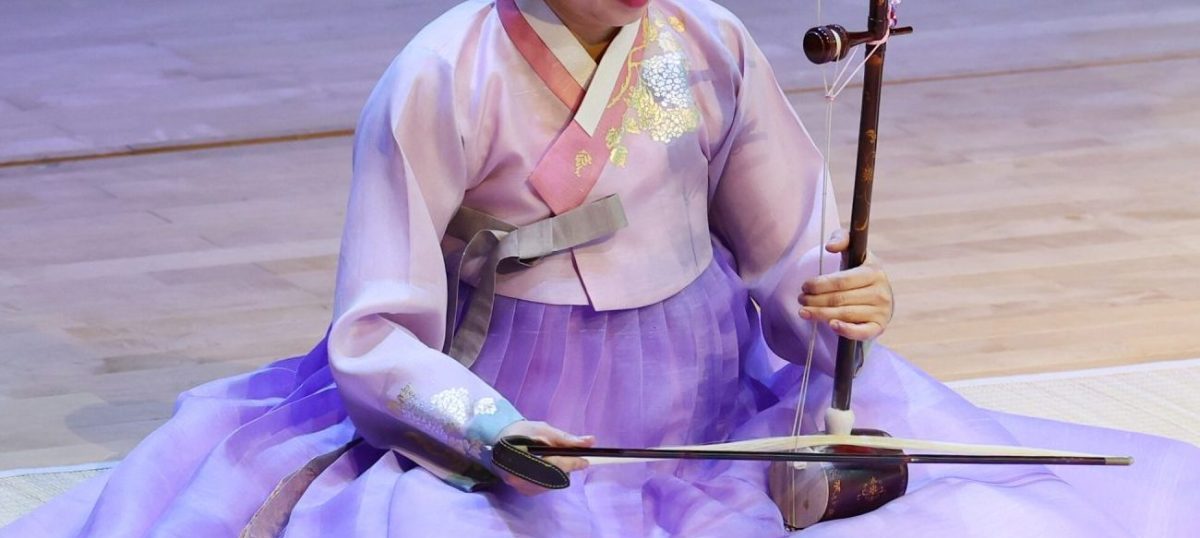
Sounds of Korea: Tradition and Continuation
Image: Lee Jeong Woo (이정우) / Ministry of Culture, Sports and Tourism via Republic of Korea from Seoul, Republic of Korea, CC BY-SA 2.0, via Wikimedia Commons
.jpg)
Organized by the IMS Regional Association for East Asia (IMSEA).
Presented by the Department of Korean Traditional Music at Hanyang University, Sounds of Korea: Tradition and Continuation surveys the principal genres of Gugak, as Korean traditional music is known in Korea, through performance and musicological commentary. Rather than a general introduction, the program is organized around a specific question: what makes a music traditional, when works that sound equally iinherited have reached their present form by such different routes? It is arranged accordingly, less as a chronology than as a set of distinct relationships to the past.
Haegeum sanjo in the school of Ji Young-hee (1909–1980) represents transmission through lineage (yupa). Sanjo emerged in the late nineteenth century as an extended solo form moving through a sequence of increasingly fast rhythmic cycles (jangdan), and it is inherited not as a fixed text but as a named line of interpretation. The passage from Simcheongga, one of the five surviving pansori narratives, belongs to the same order of transmission, a single vocalist and drummer sustaining an entire dramatic world. Yeombul Pungnyu marks a second route: a suite of the folk daepungnyu repertoire assembled and notated by Ji Young-hee himself, whose title preserves a Buddhist genealogy that the music no longer audibly carries.
Two further works are recent creations in an inherited idiom. Seo Yong-seok formed his piri sanjo in 1984 from Honam sinawi melody, extending to the piri a genre only lately established on that instrument, while Samdo Samulnori descends from a quartet first staged in 1978, drawing its material from three regional percussion traditions (garak) yet belonging wholly to the concert hall. Neoul Nori (“Waves at Play”), written in 2025 by Soonjung Suh (b. 1971) for 18-string gayageum, cello, and percussion, makes that condition explicit, pairing a reformed instrument with Western ones.
Framed by remarks from Dean Kyung-Young Chung, an introduction to the Department by Dr. Soonjung Suh, and musicological commentary by Dr. Hee Seng Kye, the program presents Korean traditional music not as a preserved inheritance but as a living practice continually reconstituted in performance.The program for this performance can be downloaded here.